Lighting control systems in Dubai — design, supply and installation
Lighting control is decided in two places that never meet: the distribution board, where the dimming actually happens, and the wall, where someone presses a button. This page sets out what Leading IT puts in each of them, who commissions what, and what the electrician needs before the walls close.
Describe the room and the programme, and the reply can be specific.
Or write to services@leadingit.me
Does Leading IT install lighting control systems in Dubai?
Leading IT designs, supplies, installs and commissions architectural lighting control systems in Dubai, United Arab Emirates, including KNX and DALI installations.
The dimming and switching are built on Crestron DIN-rail modules inside the distribution board, with Basalte, Black Nova or Crestron keypads on the wall. Occupancy and daylight sensing is added where a room earns it rather than everywhere.
Where a project is specified around a KNX bus or a DALI loop, Leading IT commissions that bus or loop as well. Crestron publishes the two modules that connect them to a control system: DIN-KXI is its KNX Secure IP gateway, and DIN-DLI is its DALI interface.
Every module named on this page is in the catalogue on this site, with its own page and its published specification. A specifier can go from here to an exact model rather than to a category.
What is the difference between KNX, DALI and Crestron dimming?
KNX is a wired bus that devices sit on, DALI addresses each fitting individually over its own loop, and Crestron dimming is Crestron’s own DIN-rail hardware. Leading IT designs, installs and commissions all three in Dubai.
The choice is usually made by the project rather than by preference. If the electrical specification already names KNX devices, the system is built around that bus. If the lighting design uses fittings with DALI drivers, it is built around DALI.
Crestron dimming is the usual choice where one platform runs the whole house. The dimming, the keypads, the processor and the interface then come from one manufacturer, with one support route behind all four.
The table below records what Crestron publishes about the two modules, and what Leading IT does. No standard wins here; the specification decides.
| Crestron dimming | KNX | DALI | |
|---|---|---|---|
| Where the dimming happens | Crestron modules on the DIN rail in the distribution board | Devices sitting on the KNX bus | Drivers inside the light fittings themselves |
| How Leading IT reaches it | Native to the Crestron control processor | Crestron DIN-KXI, a KNX Secure IP gateway | Crestron DIN-DLI, a DALI interface |
| How much it addresses | Four dimmed channels per module | Up to 1,000 KNX datapoints | One loop, up to 64 DALI devices |
| Where the bus power comes from | Cresnet, from a DIN-rail supply in the same board | DIN-KXI draws its own power from the KNX bus | DIN-DLI supplies the loop; external DALI supplies cannot be used |
| What it is set up with | The module front panel, or Crestron software | ETS5 or ETS6 software, reaching the bus through DIN-KXI | The web interface built into the DIN-DLI |
| Who commissions it | Leading IT | Leading IT | Leading IT |
What sits in the electrical board, and what sits on the wall?
In a Leading IT lighting control system, the dimming sits on the DIN rail in the distribution board and the wall holds only the keypad. That split is why board space has to be agreed with the electrician early.
Dimming modules are wide. A four-channel Crestron dimmer occupies twelve DIN module spaces, the eight-channel switching module nine, and the DALI interface three; the KNX gateway takes one. If the board is sized before the lighting control is chosen, extending it becomes a change to the electrical scope rather than the automation one.
Heat and clearance are board decisions too. Crestron publishes a minimum clearance of four inches above and below its dimming modules, and recommends six, which a board packed to the last space cannot give it.
Power and the control bus live in the same board. DIN-PWS60 supplies Cresnet at 24 volts across six ports, and DIN-HUB splits the bus into further segments once a villa or a hotel floor outgrows a single run.
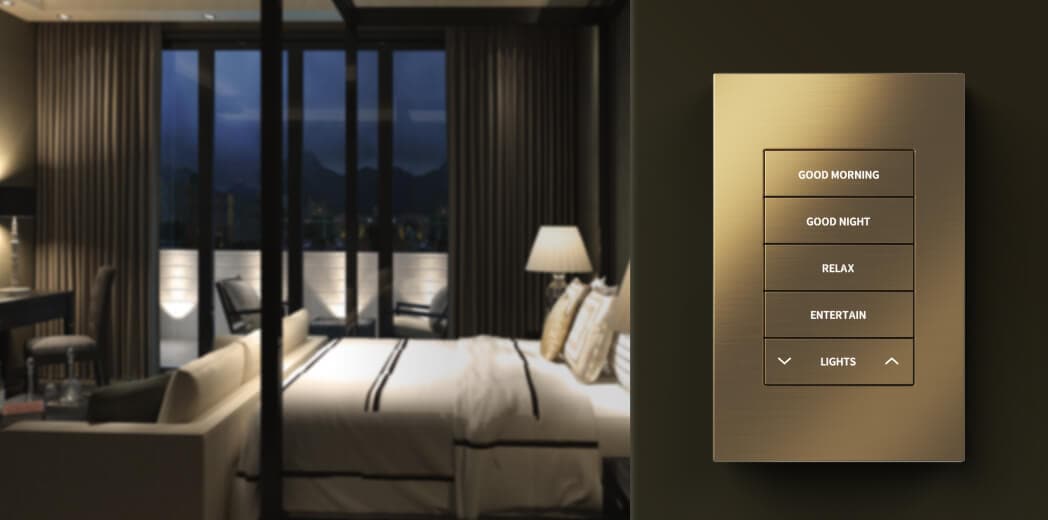
The wall holds the keypad and nothing else. Engraving, button count and finish are settled at finishes stage with the interior designer, not at commissioning. The engraving is manufactured into the plate; it is not a setting.
Sensing is one ceiling point doing two jobs. The Crestron GLS-OIRLCL-C-CN detects presence across an area of up to 450 square feet. It also reads the daylight already in the room, so the lights stay off while the room is bright enough without them.
| Module | What it does | DIN rail space |
|---|---|---|
| DIN-1DIM4 | Four dimmer channels on one feed, for leading-edge ELV, incandescent and magnetic low voltage loads | 12 module spaces |
| DIN-1DIMU4 | Four universal channels, each detecting forward or reverse phase for the load on it | 12 module spaces |
| DIN-8SW8-I | Eight switched channels for non-dimmable lighting and fans, with eight isolated inputs | 9 module spaces |
| DIN-DLI | One DALI loop of up to 64 devices, with the loop power supplied by the module | 3 module spaces |
| DIN-KXI | KNX Secure IP gateway for up to 1,000 datapoints, powered from the KNX bus | 1 module space |
| DIN-PWS60 | 60 W of Cresnet power on six ports, wired from the front of the board | 6 module spaces |
| DIN-HUB | Three further Cresnet segments, once one run is not enough | 6 module spaces |
What does the electrician need at first fix?
Before first fix closes, Leading IT issues the electrician a circuit schedule, a board space allocation, and the cable runs for keypads and sensors. The table below is that list, in the order it is usually needed.
Two items on it surprise a contractor who has only wired conventional lighting. Every keypad position needs a neutral, because a keypad is a powered device rather than a mechanical switch. And the back box has to be deep enough for the plate going into it.
The rest is coordination. The circuit schedule is agreed with the lighting designer, the board allocation with the electrical contractor, and the sensor positions with whoever is drawing the ceiling.
| At first fix | What lighting control needs |
|---|---|
| Circuit schedule | Every lighting circuit named, with its load type and the room it serves |
| Board space | Module spaces reserved on the DIN rail, with the published clearance above and below |
| Control cabling | A home run to each keypad and sensor position, back to the board or the rack |
| Back boxes | Set at the depth and gang size the specified keypad needs |
| Neutrals | A neutral at every keypad position, not only at the light fitting |
| Board and rack position | Agreed with the architect, somewhere that can be ventilated |
How are dimming curves and scenes commissioned?
Leading IT commissions lighting control in Dubai in three stages: addressing, then dimming curves, then scenes. Only the first of the three can be done before the fittings are in.
Addressing is the paperwork made real: every channel is proved to switch the circuit the schedule says it does. It is done with the electrician present, because the corrections are at the board.
Dimming curves come next. Each load type behaves differently at the bottom of its range. The curve is set per channel, so that ten per cent looks like ten per cent in the room rather than on the dimmer.
Scenes are set at night, in the finished room, with the lighting designer where there is one. A scene set from a drawing is a guess; a scene set in the room is a decision.
An astronomical clock is set at the same time, so exterior and circulation lighting follows sunset through the year rather than a fixed hour. A return visit once the client has lived with the house is normal, and is where the scenes usually settle.
Which lamps and drivers dim properly?
Leading IT specifies lighting control in Dubai around the drivers the fittings actually contain, because a dimmer and an LED driver have to agree before anything dims smoothly.
The failure everyone meets is an LED that flickers or drops out near the bottom of its range. Two things cause it: the dimmer is driving the load on the wrong phase, or the circuit sits below the minimum load the module needs to see.
Phase is the first of those. Crestron publishes leading-edge support on the DIN-1DIM4, for electronic low voltage, incandescent and magnetic low voltage loads. The DIN-1DIMU4 detects forward or reverse phase on each channel, and each channel can also be set by hand.
Minimum load is the second. Each module publishes a minimum wattage per channel, and a single low-power LED downlight alone on a circuit can sit below it. That is a specification problem rather than a fault, and it is cheaper to find on a schedule than on site.
No lamp brand is endorsed here, because compatibility is a property of the specific driver rather than of the name on the box. Send the fitting schedule and the drivers can be checked against the module before anything is ordered.
Does Leading IT supply lighting control to Pakistan?
Leading IT supplies lighting control equipment to projects in Pakistan from its Dubai base.
Modules and keypads ship from Dubai, commissioning support is given remotely or by a visit, and warranty claims are routed through the same team that supplied the goods. There is no Pakistan office and no local address; the relationship is supply and support, stated as exactly that.
Common questions
Do I need KNX or Crestron for a villa in Dubai?
- Neither is the right answer on its own. The deciding factor is whether the electrical specification already names KNX devices: if it does, that bus stays and a Crestron DIN-KXI brings it into the same interface. If the lighting is still being specified, a single-platform Crestron system is simpler to own, because the dimming, the keypads and the processor share one support route.
Can lighting control be retrofitted into a finished villa?
- Partly, and the constraints are physical rather than technical. The board needs space for the modules, every keypad position needs a neutral, and the back boxes have to be deep enough for the plate. Where those three exist a retrofit is straightforward; where they do not, the work becomes an electrical alteration rather than an automation one.
Why do my dimmable LEDs flicker?
- Usually one of two reasons: the dimmer is driving the load on the wrong phase for the driver, or the circuit is below the module’s published minimum load. Both are settled at specification stage rather than by turning something up afterwards. Sending the fitting and driver schedule is what makes the answer specific.
Can I keep my existing light fittings?
- Usually yes, with one caveat: it depends on the driver inside the fitting rather than on the fitting itself. Electronic and magnetic low voltage loads generally want leading-edge dimming and many LED drivers want trailing edge, which is why a universal module exists. Fittings whose drivers are not dimmable at all cannot be dimmed by any control system.
What does lighting control cost in a Dubai villa?
- It is quoted per project. The figure follows the number of dimmed and switched circuits, the keypad count and finish, the board space available, and whether KNX or DALI is in the specification. A circuit schedule and a keypad count therefore produce a far more useful answer than a room count.
Still deciding? Send the drawings or the room dimensions for a specific answer.
Or write to services@leadingit.me